What Size Jump Starter Do I Need? Match It to Your Engine
The number on the jump starter box and the number your engine needs are not always friends.
Jump starter boxes love big amp numbers. What those numbers do not tell you is whether the unit will start your car, pickup or diesel on a cold morning. That answer is printed somewhere much less exciting: your engine size.
This guide sizes a portable jump starter the plain way, using the maker's own engine ratings. For the full list of buying checks, such as safety features and storage limits, see our portable jump starter guide. This post sticks to one question: what size?
Quick answer: Pick a jump starter that its maker rates for your engine size and fuel type. Diesel engines get a much lower rating than gas engines on the same unit. If your engine sits near the top of a model's range, or you live where winters get very cold, I would go one size up. Buy the size your engine needs, not the biggest number on the box.
Match the jump starter to your engine size and fuel type
NOCO puts it simply on its Boost support page: Boost models are based on the vehicle engine size, so look up your engine size and choose the model that fits. The job comes down to three steps:
- Find your engine size in liters.
- Note whether it is gas or diesel.
- Pick a model whose rating covers both, with some room to spare if you face hard winters.
Find your engine size (where to look)
The engine size is written down in a few places:
- Under the hood. Every vehicle is required to have a permanent label called the Vehicle Emission Control Information label, according to the EPA's fueleconomy.gov site. It lists the engine size, usually in liters, such as 3.2 L. The California Air Resources Board says it is most often on the underside of the hood.
- The owner's manual. Look in the specifications section. If the manual lists more than one engine, match it to the label under the hood.
- The original window sticker, if you bought the vehicle new and kept it.
Check the label with the engine off and cool, and snap a photo of it for shopping.
A simple sizing guide for gas engines
Here is how NOCO rates its standard Boost line on its GB40 support page (the ratings are NOCO's, not ours, and other brands use their own charts):
| NOCO Boost model | Gas engines up to | Diesel engines up to |
|---|---|---|
| GB20 | 4.0 liters | not rated for diesel |
| GB40 (Boost Plus) | 6.0 liters | 3.0 liters |
| GB50 | 7.0 liters | 4.5 liters |
| GB70 | 8.0 liters | 6.0 liters |
| GB150 | 9.0 liters | 7.0 liters |
For a gas engine, read across to find the first model rated at or above your size. A 2.5 liter engine sits well inside the GB40's 6.0 liter gas rating. A 5.7 liter engine is inside it too, but near the top, which is where the cold-weather advice below comes in. A gas engine bigger than 6.0 liters needs a larger model, such as the GB70.
Whatever brand you look at, use that maker's own chart for the exact unit.
Diesel engines need more
Look at the diesel column again. The same GB40 that covers gas engines up to 6.0 liters is rated for diesel engines only up to 3.0 liters. The GB70 goes from 8.0 liters gas to 6.0 liters diesel.
If you drive a diesel, find its size and read the diesel column only. A diesel larger than 6.0 liters is beyond the GB70's diesel rating on NOCO's chart and needs a model rated for it, such as the GB150 at up to 7.0 liters.
One more check for trucks: NOCO says that if two batteries are wired in series, no 12-volt Boost unit will work and a 24-volt jump starter is needed. AAA also says to confirm the voltage printed on the battery label.
Cold weather: size up
AAA explains that a car battery makes power through a chemical reaction, cold slows that reaction, and starting an engine in winter takes more power.
The maker's chart tells you the largest engine a unit is rated for. That is why I would go one model up if your engine sits near the top of a unit's range or you live where winters get hard, as they do in much of Colorado.
The jump starter has limits too. NOCO lists an operating range of -4 to 122 degrees F for its Boost units, with thermal sensors that stop the unit outside that range. On a very cold night, keeping the unit indoors and carrying it out to the car is a sensible habit.
Peak amps vs what actually matters
NOCO lists the GB40 at 1,000 amps (peak) and the GB70 at 2,000 amps (peak). Those are the big numbers on the box. But NOCO itself sorts its models by engine size, not by amps, and that is the number to shop by.
If a box shows a huge amp number and no clear engine-size rating, keep looking.
Free every Sunday
Get the free Sunday Roundup
Trucking headlines, road stories, useful gear finds and a few laughs, in your inbox every Sunday.
Jump starter vs jumper cables vs battery charger
These three do different jobs:
- Jumper cables move power from a second running vehicle. AAA notes that thin cables are a frequent point of failure with larger V6 or V8 engines or in freezing weather, and suggests a heavy-duty set of six-gauge, 16-foot cables.
- A portable jump starter lets you start the car yourself, with no second vehicle. AAA's Via magazine reminds owners to charge it as the maker recommends.
- A battery charger refills a car battery over time. NOCO is clear that its Boost jump starters are not battery chargers.
A jump start gets the engine running. It does not leave you with a full battery. AAA suggests a continuous drive of 20 to 30 minutes afterward and getting the battery tested if it keeps happening. Some models add an air compressor; if that interests you, our portable tire inflator guide covers what to check on the inflator side.
Safety basics before you use one
Read your vehicle owner's manual first, then the jump starter's own guide. From NOCO's GB40 user guide and AAA's jump-start article:
- Use it only on the battery type it is made for. NOCO says Boost units are for 12-volt lead-acid batteries only, not 6-volt or lithium batteries.
- Never jump a frozen, cracked or bulging battery. AAA says a damaged battery must be replaced, not jumped.
- Wear eye protection and remove rings and watches.
- Keep the cables clear of fans, belts and the hood.
- Follow the rest limits. NOCO's GB40 guide says not to try more than five jump starts in a row within 15 minutes, then to let the unit rest for 15 minutes.
If the car still will not start, or you are parked somewhere unsafe, stop and call for roadside help. It may be the starter or alternator, not the battery.
Look after it: charge it before winter
A jump starter only helps if it has a charge. NOCO says its Boost units arrive partially charged, so charge one fully before first use. After that, NOCO says the units hold 70 percent of their rated capacity for up to one year and recommends charging at least every 4 to 6 months.
NOCO also says not to leave a Boost unit in direct sunlight in a car and to recharge it between 32 and 104 degrees F. A calendar reminder each fall and spring helps. Keep it with the rest of your winter car emergency kit, and if snow is part of your winter, our guide on what to do when your car is stuck in snow pairs well with it.
Gear mentioned in this post
- NOCO Boost Plus GB40: rated by NOCO for gas engines up to 6.0 liters and diesel up to 3.0 liters, a fit for gas engines up to that size.
- NOCO Boost GB70: rated by NOCO for gas engines up to 8.0 liters and diesel up to 6.0 liters, worth it for bigger engines, smaller diesels or hard winters.
FAQ
What size jump starter do I need for my car?
Find your engine size in liters, then pick a jump starter whose maker rates it for at least that size and fuel type. On NOCO's chart, for example, the Boost Plus GB40 is rated for gas engines up to 6.0 liters.
What size jump starter do I need for a diesel truck?
Diesel ratings run much lower than gas ratings on the same unit. NOCO rates the GB40 for diesel engines up to 3.0 liters and the GB70 for diesel engines up to 6.0 liters. A diesel larger than that needs a model rated for its size.
Is a bigger jump starter always better?
Not always. A bigger unit costs more and weighs more. A diesel needs a model rated for its size in the diesel column, which is often a bigger unit. I would also go one model up if your engine sits near the top of a model's rating or you live where winters get very cold. Otherwise, the size your engine needs is enough.
How often should I charge a jump starter?
Charge it fully before first use. NOCO says its Boost models hold 70 percent of their rated capacity for up to one year and recommends charging at least every 4 to 6 months. Check the manual for your own model.
Jump starter or jumper cables: which is better?
Jumper cables are cheap but need a second running vehicle. A portable jump starter lets you start the car on your own. Neither one charges a battery fully, so plan a drive afterward and get the battery tested.
Sources and image note
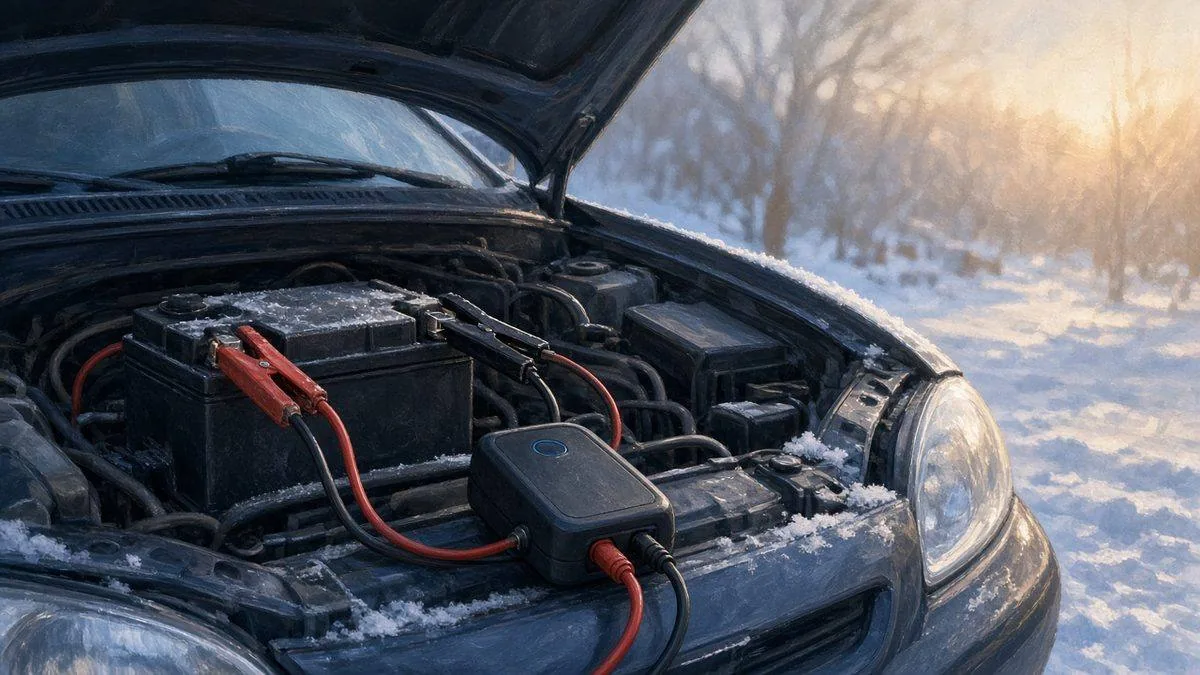
Sources reviewed November 11, 2026: NOCO GB40 support and Boost sizing chart; NOCO GB40 product page; NOCO GB70 product page; NOCO GB40 user guide; fueleconomy.gov engine size and underhood label; California Air Resources Board on locating the emission label; AAA how to jump a battery; AAA Via on cold weather and batteries. The header is an AI-generated editorial illustration, not a real customer incident or evidence of product testing.
Related articles you may find useful
Read next: Portable Jump Starter for Winter: 9 Things to Check
Read next: Winter Car Emergency Kit: What to Keep in Your Car in Winter
Winter car prep tips go out in the Sunday Roundup.